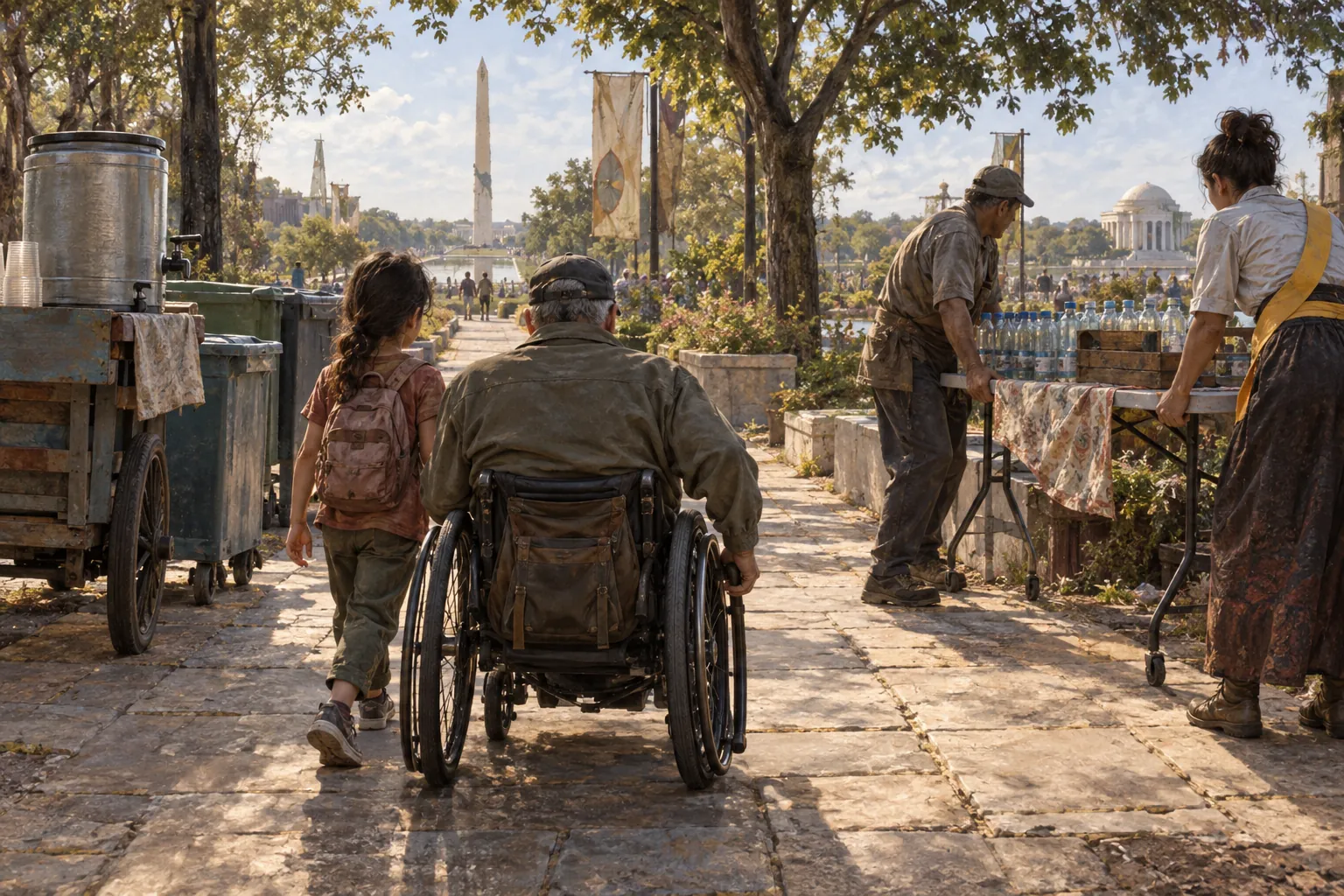
National Mall, Washington · June 23, 2230 · Afternoon
The first person to tell Olga that the path was open was standing in it.
He wore a yellow sash and held a rope at waist height. Beyond him, the old walkway showed itself in pieces: stone, a table, a water cart, more stone. People had found their ways through. Olga wanted to know whether they could find their ways out again.
“Move your feet,” she told the man.
He did, politely. It gave her the width of one foot.
She had come with wrapped bread and the stubborn intention to hear Joshua for herself. At the Commons, reports about him tended to leave out the distance to a seat and the price of getting home.
Ahead of her, a girl pushed a low chair on wheels with a man in it. He used one hand to steer around a loose stone while the girl kept the chair from tipping toward the dry ground. They stopped at the water cart. A bottle seller's folding table had claimed the solid half of the path, leaving a tilted strip between a monument fence and two bins.
“We can go around the grass,” the girl said.
The man looked at the ruts. “We can go around when grass is paying for the wheels.”
Olga set down her basket. “Whose table?”
“Mine,” said the seller. He was about her age, with the careful voice of someone who had explained the same thing all morning. “I bought this space from the event steward. Third marker from the corner.” He pointed to a white slash almost hidden by a table leg. “If I move, the next seller will say I took his frontage.”
“Then we need the steward.”
“That is what I've been saying.”
He meant it as a complaint. Olga found it promising.
From the stage came an argument about the power lead. A woman carrying cable hurried past, looked at the chair, and said, “We'll have the sound back shortly.”
“We need the ground back,” Olga said.
Her name strip read MIRI, STEWARD. She showed Olga the plan on her slate. The walkway was marked CLEAR ACCESS in blue. Three paid vending positions lined its edge. The table stood exactly where its white slash told it to stand.
“The plan is wrong,” Olga said.
“The marks are wrong,” Miri replied. “The plan has a lane. The marks put the lane under the stalls.”
The seller, Enno, showed Miri his receipt. He had paid two shifts' wages because the audience arrived from that corner. His bottles were refillable, his prices visible, and the free water cart had been placed behind him after he paid. If moved to the outer lane without a sign, people would think he sold the free water.
Olga liked him better for knowing the difference.
The girl introduced herself as Niva and her uncle as Lev. Lev asked whether the path to the north shade stayed firm all the way. No one knew. Miri had measured the entrance, not the turn beside the fence.
“I'll go see,” Olga said, and handed Niva a piece of bread. “For the inspection staff.”
The north shade was real. So was the turn: a narrow elbow between a bin and people displaced from the central view. Three empty chairs stood beyond it, marked PRIORITY SEATING. A family had left bundles on one. A fourth held the stage battery. Olga asked before touching either and returned with the boy guarding the battery.
“Can it sit on the ground?” she asked him.
“It must stay dry.”
“Can it sit on a crate?”
“If we have a crate.”
Enno had two. He needed one beneath his bottles to keep them out of the dust. He lent the other when Miri wrote its return on the back of his receipt. The boy lifted the battery; the family took their bundles; Olga and Miri moved the empty chairs so someone could use them without turning a public seat into an obstacle course. Lev did not want one. He wanted to keep his own.
Moving the table was slower. Enno would not abandon a paid place on a spoken promise, and Miri had no authority to refund him from the day's box. Olga refused to call that obstinacy. They found the event clerk behind the stage, counting deposits under the awning. He checked the white slash, then the blue line on Miri's slate. He could move the position to the firm outer edge and sign that Enno had not surrendered his fee. He could not promise the same frontage tomorrow or return two shifts from money already allocated to the battery crew.
“Today is the day with the chair,” Olga said.
“Today I can sign,” the clerk said.
So he signed. Miri carried a board to the new spot: BOTTLES SOLD HERE · FREE REFILLS AT THE CART. Enno corrected her: refills from his bottles were also free, but the cart supplied the water. They rewrote the sign. Then Enno and the yellow-sashed man lifted the table, and Niva, who had been waiting longer than anyone, chose not to help them. She kept her hand on Lev's chair while he crossed the newly cleared stone.
It was not a wide road. The water cart still made people slow down. Miri moved one bin, marked the turn with a second blue stroke, and stationed the yellow sash where he could answer a question without becoming the answer's physical obstruction. She wrote CHECK AFTER THE NEXT CROWD ARRIVES on her slate. Olga approved of a plan that admitted the next crowd existed.
The sound came back with a cough from the stage. Somewhere above the heads, Joshua was speaking again. Olga caught a sentence and lost the next to the scrape of Enno's crate. She could have pushed toward the front. Instead she sat under the north shade, close enough to hear what reached her. Niva broke her bread in half and gave the larger piece to Lev, who objected on principle and ate it anyway.
Miri came by with the clerk's signed copy for Enno. “There will be another gathering,” she said. “I can put the correct marks on tomorrow's plan.”
“Put a person in the chair and try it first,” Olga said.
Miri looked at Lev. “May I ask you?”
“You may ask,” he said. “After I finish listening.”
They left him to it. The path stayed open through the next arrival, and then through a family carrying a folded stool, though Olga watched both crossings. When she finally turned her face toward the stage, she did not have to stop watching the way home.