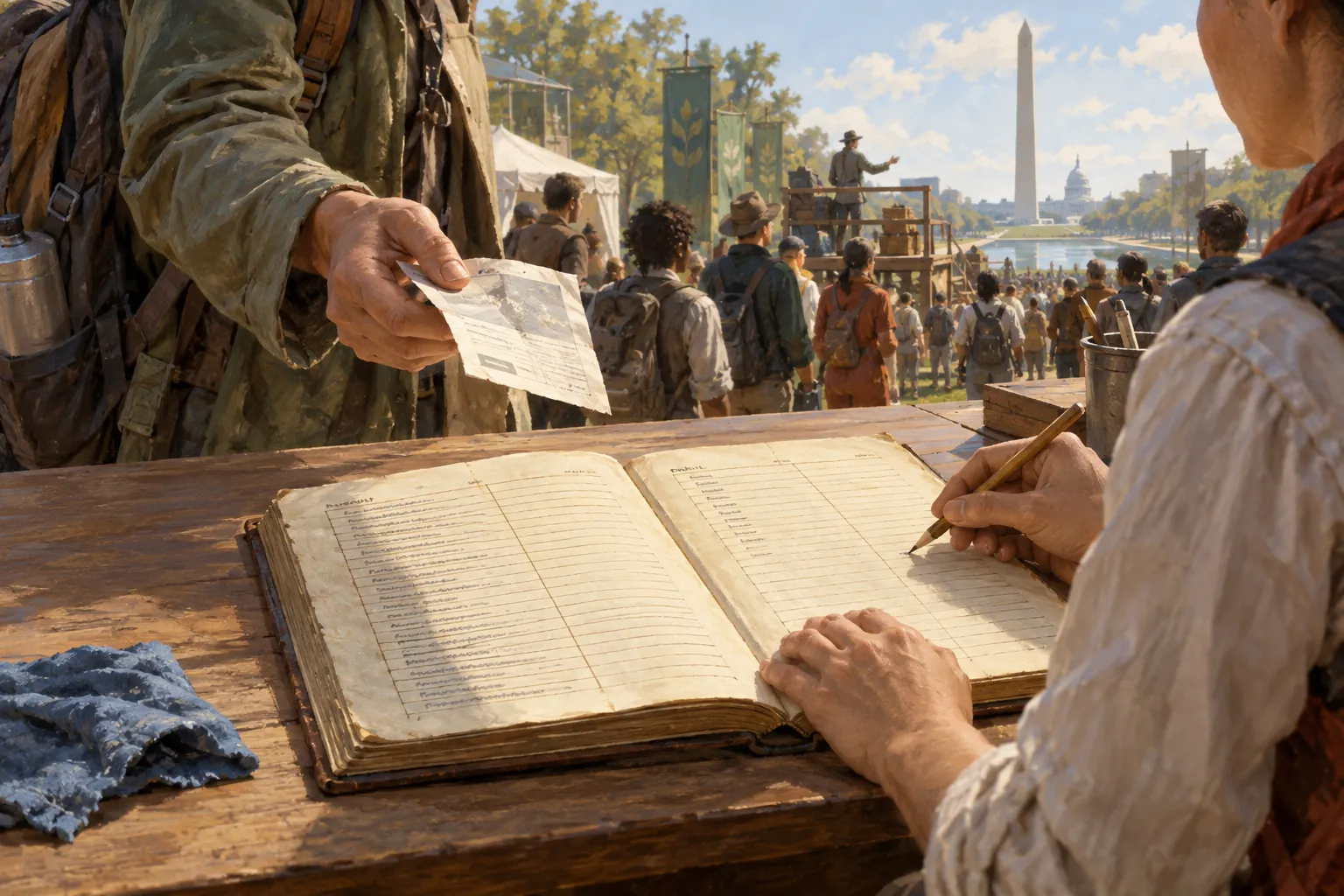
The National Mall · Washington, D.C. · June 23, 2230, daytime
The largest word on the poster was JESUS. The next largest was RETURNS. At the bottom, where a person had to crouch to read it, a clerk had written BED DEPOSITS AT THE BLUE TABLE.
Joshua crouched. The table was not blue. It had a blue rag on one corner, held down by a stone. A woman standing beside it had been sending arrivals to the linen cart because she thought bed meant a place to rest while they waited.
“It means overnight,” said Neri, the booking clerk. “If there are any beds left.”
Neri could write legibly on paper balanced against her knee. She was also the person people blamed when a promise made in larger letters could not fit into her little book. Her thumb was blue from recopying route instructions.
“How many?” Joshua asked.
“Paid for? Seventeen beds. Confirmed? Fourteen, unless the west house opens its upstairs.”
“Why does the sign say deposits?”
“Because they were paid.” Neri pressed the book closed. “Some bought passage on the strength of them. Please don’t tell me to return the money unless you’re bringing it back from the drivers, the water carriers, and the latrine crew.”
The crew was already working. Two people rolled a full waste barrel along the outer lane while a third kept the crowd from closing behind it. Beyond them, somebody argued with a bottle seller about the price of a refill. In the stage’s shade, three batteries waited under a canvas cover. The Mall could still make any small figure look important, provided no one looked at what it took to keep a thousand small figures standing.
At the blue rag, a woman unfolded a receipt. She wore a traveling coat with one sleeve cut open to let her brother’s arm through. He was older than she was and carrying his own bag.
“Mara Tor,” she said. “Two places for tonight. I was told the bed was certain.”
Neri checked. “Your deposit is here. The upstairs room isn’t confirmed.”
“Then tell me the address where it is confirmed.”
“I can give you the supper place now.”
Mara folded the receipt again, carefully enough that it did not tear. “He can eat sitting up. That wasn’t the question.”
Her brother said, “Mara, I can ask my own question.” He turned to Joshua. “Will you pray with me?”
Joshua had practiced the answer to the question people usually asked him. He had never had much practice answering one this plain.
“Yes,” he said. “If you want.”
“I do. After we know where we’re sleeping.”
The brother introduced himself as Teren. He had traveled because he believed prayer was worth a hard road. He had also traveled because the notice said a bed would be waiting. He did not seem confused about the difference.
Behind them, a handler named Sol brought a strip for Joshua to approve before the noon address. It described places held for all who have pledged. Sol had spent the morning moving the speaking platform so that wheelchair wheels could reach its side without crossing the power cords. He held the strip out with hands still dirty from the work.
“The people already on the way need to hear we’ve kept faith,” Sol said.
“Have we?” Joshua asked.
Sol looked toward the barrel crew. “I’m trying to. If you announce that nothing is ready, they’ll turn around at the last checkpoint. Then the carriers who’ve hauled water here won’t be paid. Nor Neri.”
Neri had heard her name. “I’d prefer being paid for what I have done to being called proof of a promise nobody checked.”
Joshua took the strip. In the Reverend’s old rooms, the trick had been to make uncertainty sound like a test of the listener. Outside them, he had learned softer versions. A qualification might disappoint the person nearest the stage. Omitting it could cost the person farthest away a night on stone.
He turned the strip over and wrote on its blank side. The point of the pencil broke. Neri gave him hers without a word.
At noon, he did not begin with a blessing. He asked the crowd to make a lane for the full waste barrel. It took longer than applause would have, and the crew went through without raising their voices.
Then Joshua read the counts Neri had given him. “Seventeen beds confirmed,” he began.
Neri climbed the short stair and pointed to two columns in her book. “Seventeen paid for. Fourteen confirmed,” she said into the horn. The crowd heard her, too. Joshua read the corrected line, then the three names waiting on the west house.
“If you paid for a bed,” he said, “your receipt is a claim we owe you an answer to. It is not proof that the bed exists. No new overnight deposit will be taken at this gathering until we can give each new payer a written address for a confirmed place. We still owe the people already in Neri’s book. The table will stay open for those names, and for anyone who wants their receipt copied before deciding what to do.”
Sol stood below the platform, watching the new line form. Joshua did not promise a refund he could not fund, or say that prayer would make the arithmetic merciful. When he invited people to pray, he said they could do so without paying and could leave the line without explaining why.
Mara stayed in the booking line. Teren left it long enough to sit beside Joshua in the narrow patch of shade behind the stage. They prayed quietly, with the sound of Neri calling names and a wheel rattling over broken paving nearby.
When they finished, Teren asked whether the west house had answered.
“Not yet,” Joshua said.
“All right.” Teren stood with his bag. “Then we ask again.”
Joshua went with him to the blue rag. Neri had turned it over so the clean side showed. She handed Mara a copied receipt, and kept the original number visible in her book.
The poster above them still had the larger words. Joshua asked for paper large enough to put the smaller ones where a person standing could read them. Neri gave him two sheets. Until the west house answered, there was no address to write on them.